
 Sign in
 Create Account

SSL certificates for banks
Sectigo, DigiCert, Thawte and GeoTrust certificates for institutions that move money. With OV and EV the certificate authority checks your company against public registers and writes the result into the certificate itself.
- Your institution is verified The certificate authority checks the legal name, registration number and address, and puts them in the certificate.
- Warranty from the certificate authority Each certificate carries the authority’s relying-party warranty, paid to the party who relied on a mis-issued certificate.
- Trusted everywhere The roots ship with current browsers, phones and operating systems, so no customer meets a warning on your login page.
- OV in 2–3 days, EV in 7–10 Counted from the moment the certificate authority has your documents — the figures our product pages quote.
- CA/Browser Forum LeaderTelecom is an Interested Party of the CA/Browser Forum.
Certificates for banks
Every certificate here encrypts the same way. They differ in how much of your institution the certificate authority checks before it issues, and in how many domains one certificate covers.
Four brands, two certificate authorities: Sectigo issues the first, DigiCert the other three — Thawte and GeoTrust are DigiCert brands. It matters if your continuity policy asks for a second, independent authority.
Sectigo (Comodo) EV SSL certificate
Issued by Sectigo
Sectigo EV for a single banking domain
from €138,96 / year
Buy nowDigiCert Secure Site EV SSL-certificate
Issued by DigiCert
Premium line from DigiCert itself
from €800,89 / year
Buy nowThawte SSL Web Server with EV certificate
Issued by DigiCert
Long-established brand at a mid-range price
from €243,80 / year
Buy nowTrue BusinessID with EV Multidomain SSL-certificate
Issued by DigiCert
EV for several banking domains in one certificate
from €279,15 / year
Buy nowWhat you get from LeaderTelecom
- Partner of the certificate authorities LeaderTelecom is a strategic partner of Sectigo and an official DigiCert partner with the status of Website Security Solutions Specialist.
- Free unlimited reissues Reissue the certificate as often as you need — a new server, a replaced private key or a corrected name — at no extra cost.
- 14 years on the market We have been ordering certificates, following validation and reissuing them since 2012.
DV, OV and EV for a bank
All three protect the connection in exactly the same way. They differ in how much of your institution the certificate authority checks before it issues, and in how long that takes.
| What differs | DV | OV | EV |
|---|---|---|---|
| Encryption | Identical | Identical | Identical |
| What the authority checks | Control of the domain | The domain and that the company exists | The domain and the company, under CA/Browser Forum rules |
| Company details in the certificate | None | Legal name and address | Legal name, address and registration number |
| Documents you provide | None | Company registration | Company registration and confirmation of the request |
| Time to issue | Minutes | 2–3 working days | 7–10 days |
| For a bank | Test and staging sites | Internal systems and sites that name the institution | Customer-facing banking and payment pages |
Scroll the table sideways to see every column.
What the rules ask of a bank
A certificate answers one requirement and leaves others open. Both matter to an institution that takes card payments or reports under FATCA.
- PCI DSS 4.0.1, Requirement 4.2.1 — the certificate protecting card data in transit has to be trusted, valid and not revoked. A certificate from this page does that.
- PCI DSS 4.0.1, Requirement 11.3.2 — an external scan by an Approved Scanning Vendor at least every three months, repeated until it passes. A certificate does not cover this.
- FATCA data reaches the IRS through the IDES portal, and enrolment there requires a certificate issued by a publicly trusted certificate authority.
Which self-assessment questionnaire applies to your institution is decided by your acquiring bank.
Banks whose sites run on EV certificates
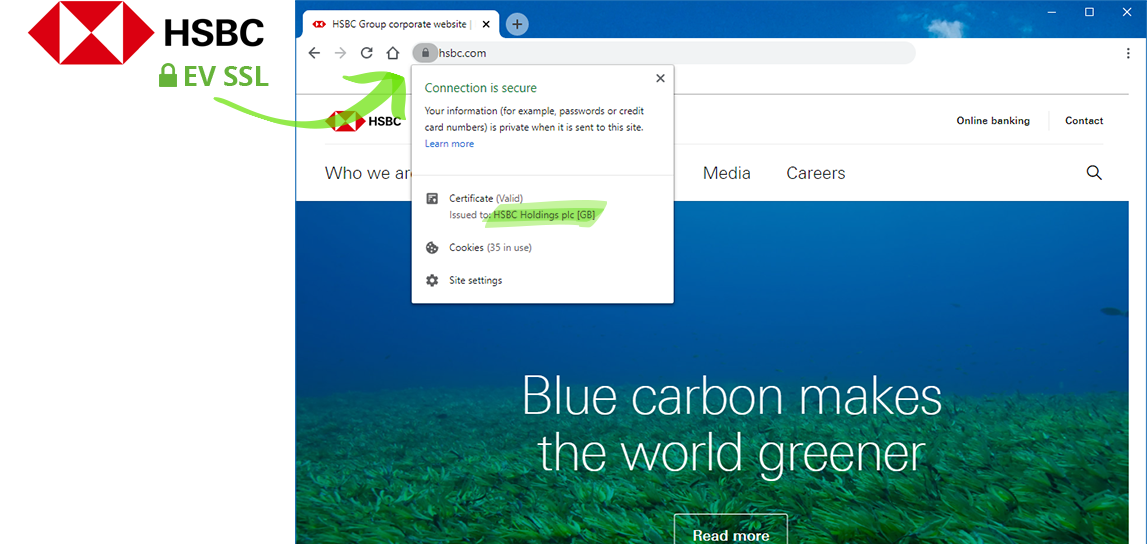
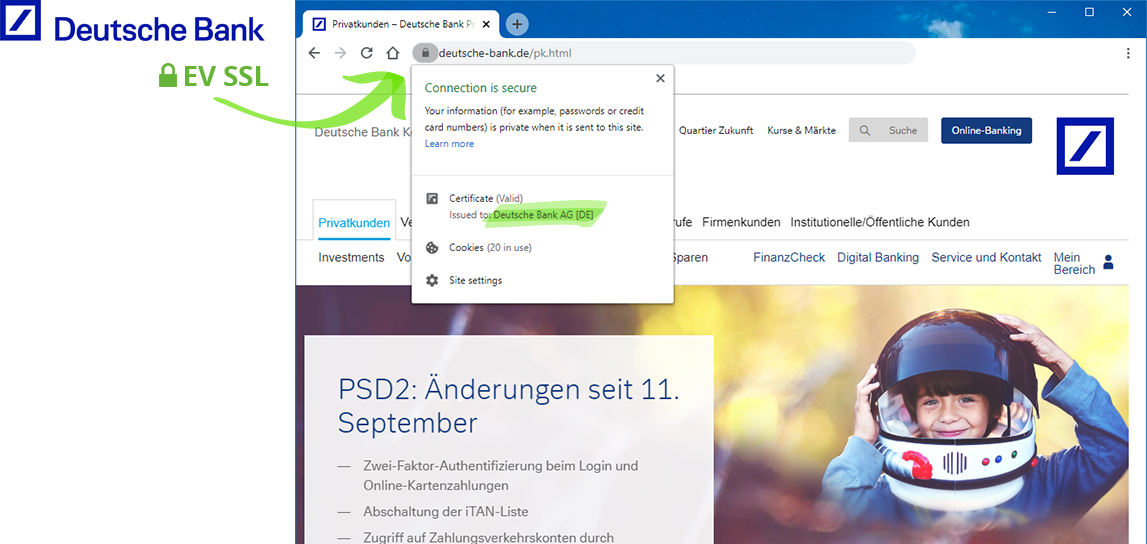
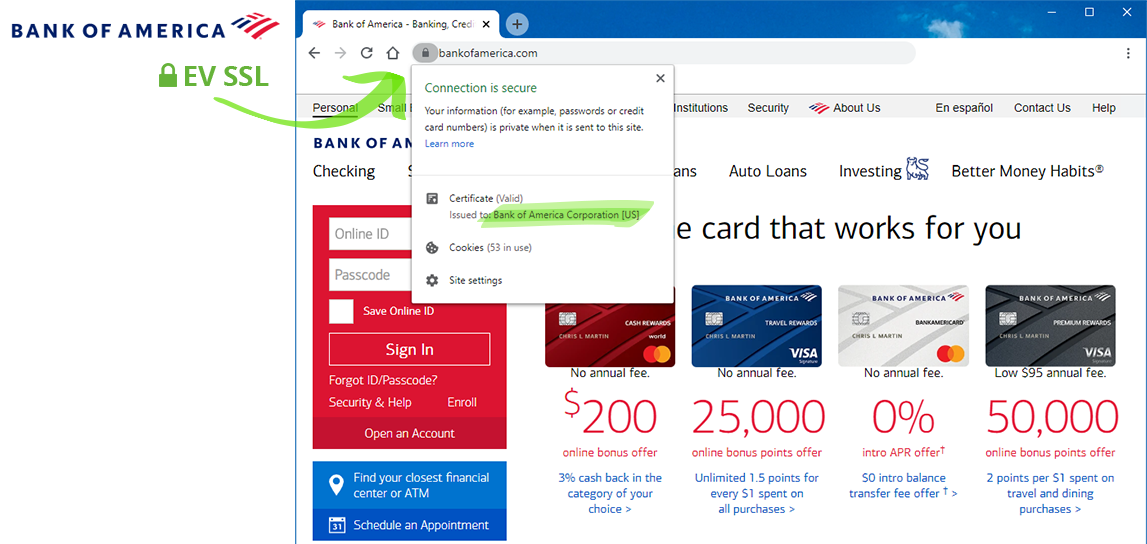
Each screenshot is the bank's own site in Chrome with the certificate panel open: the address bar shows no company name, the certificate does.
Our clients























Support for your certificate
We place the order with the certificate authority, follow the validation with you and reissue the certificate when you need it. Installing it on your infrastructure is your side, and we tell you how.
- Email info@leadertelecom.nl
- Phone +31207640722
- Hours Monday — Friday:, 9:00 - 18:00 CET time
- Language English
Questions banks ask
Which certificate does a bank need?
DV proves only that you control the domain. OV and EV also put your checked institution into the certificate. A bank that takes payments or reports under FATCA is normally on OV or EV.
Will our name be shown in the browser?
No. Browsers removed that indicator in 2019, and in 2023 Chrome replaced the lock icon with a settings icon. The verified details live in the certificate, which anyone can open from the site information panel.
Do we need a certificate for FATCA reporting?
Enrolment in the IRS IDES portal requires a certificate from a publicly trusted certificate authority, alongside a valid GIIN. We help you pick one that fits the enrolment.
Does a certificate settle PCI DSS for us?
No. PCI DSS 4.0.1 asks for a trusted, valid certificate under Requirement 4.2.1 and, separately, a scan by an Approved Scanning Vendor every three months under Requirement 11.3.2.
How long does issuing take?
A DV certificate is issued within minutes. OV takes 2–3 working days and EV 7–10 days, counted from the moment the certificate authority has your documents.
How long will the certificate stay valid?
Certificate lifetimes are shrinking by CA/Browser Forum ballot SC-081v3: at most 200 days for certificates issued from 15 March 2026, 100 days from 15 March 2027 and 47 days from 15 March 2029.
We run several banking domains. One certificate or several?
A multi-domain certificate covers several names at once; separate certificates are simpler to move between servers and to revoke independently. We help you compare the two for your list of domains.
Who is the warranty for?
The certificate authority pays it to the party who relied on a certificate it mis-issued, not to the certificate holder. Treat it as a measure of the authority’s confidence, not as insurance for your institution.


